
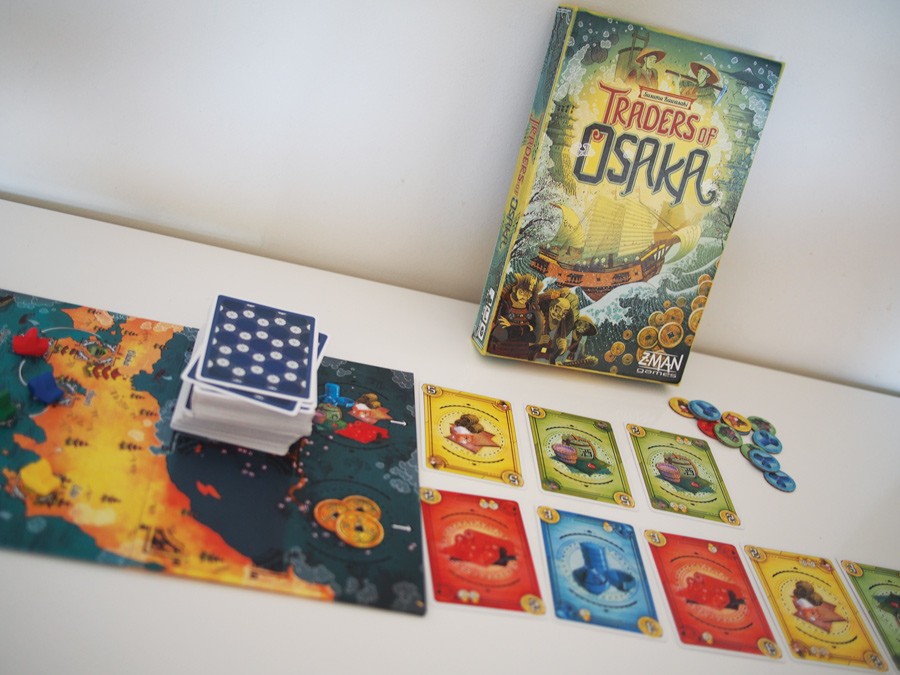

I’m an absolute sucker for elegance. I love games with few components and rules, yet still manage to create a deep and thoughtful gameplay system. The card game Traders of Osaka has all of these traits.
Based on Traders of Carthage, where the goal is for players to move ships, and deliver goods from Alexandria to Carthage, Traders of Osaka is essentially the same but this time the gameplay is set in a new continent and era, with the cargo needing to be shipped from Osaka to Edo in Japan.
The game has both cards and a board. Each card has a number and colour. The colour denotes the type of goods you can ship, and the number indicates their value. But, the game gives you the choice to keep your card in hand or place it in front of you. This turns them into purchased goods or cash to use later to purchase the goods.
Apart from this choice, as a trader you need to move your goods. Each time you buy an item, the ship of its colour moves one step closer to its destination. When it reaches Edo the player can sell the goods of a specific colour. However, if the seas are perilous just before docking, it sinks, and everyone’s goods of that colour go to waste.
The setup leads to a very simple, binary choice, which is affectd by the actions of all the players around you. The competition is absolutely bittersweet. Don’t be fooled by its spareness, these are some of the most tactical choices you will have to make in your life.
The game is about trading rice in Osaka over 100 years ago—a hard sell. But it has beautiful artworks, and a modern design that runs smoothly and is easy to learn. Trust me, give this one a shot.




Comments are closed for this article!