
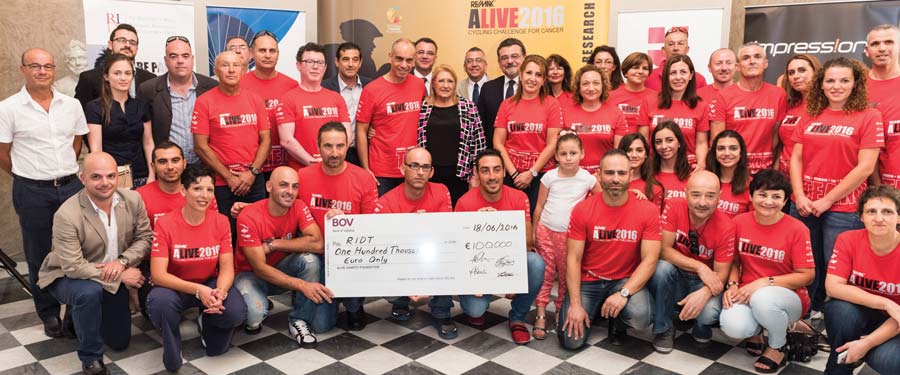
Wilfred Kenely, the Research Trust (RIDT) CEO, speaks to THINK about new initiatives coming to fruition thanks a new scheme.
Maltese researchers are hungry for the means to make their ideas happen. The Research Trust (RIDT) launched a scheme this year to try and make some of these ideas a reality.
Dr Vince Briffa (Faculty of Media & Knowledge Sciences) will be installing a Holographic and three-dimensional audio project, creating a sculpture that can be used in art galleries, performances, visual arts installations, movie projections, and digital games among others. Dr Paul Refalo and Dr Christopher Micallef (both Faculty of Engineering) will be designing and testing devices to recover and reduce the energy required to heat and cool plastic injection moulding equipment, while Dr David Mifsud (Institute of Earth Systems) and Dr Marion Zammit Mangion (Faculty of Medicine & Surgery) will be conducting studies to identify genetically pure colonies of a particular bee species in the Maltese Islands. Dr André Xuereb (Faculty of Science) will be testing the first ever quantum-enabled telecommunications link between Malta and Sicily.
These are a few of the fifteen projects that are being funded under the RIDT scheme for small project grants to increase the research activity across all areas of study at the University of Malta. The projects cover a wide spectrum of faculties and institutes. They offer new opportunities for researchers, while bringing flexible and accessible funding. This first call was intended to fund projects such as feasibility studies for larger projects, proof of concept projects, and small, self-contained projects.
The response for the call was overwhelming. Eighty project proposals were submitted to the scheme which needed a budget of over half a million euros. They were evaluated primarily on excellence, impact, and budget. The initial budget was bumped up to €69,000 to include more of these exciting projects. The funded projects range from science and medicine, to digital arts and archaeology. Research is actively happening in every part of the University of Malta despite the little funding available. The RIDT is committed to continue raising the much needed funds so that this call can be repeated in the future. Since its setting up, the RIDT has managed to raise over €1 million, most of which was tied to particular projects. The call for funding of small projects was intended to support projects which do not fall into the category of projects that would normally attract funding, and remain largely under-funded. To be able to repeat and sustain these funding programmes, the RIDT is introducing a number of schemes that generate revenue streams that trickle into the general kitty. Such schemes include the University Staff Contribution Scheme, the payment gateway scheme, and others that will be introduced in the near future—every little bit counts.




Comments are closed for this article!