
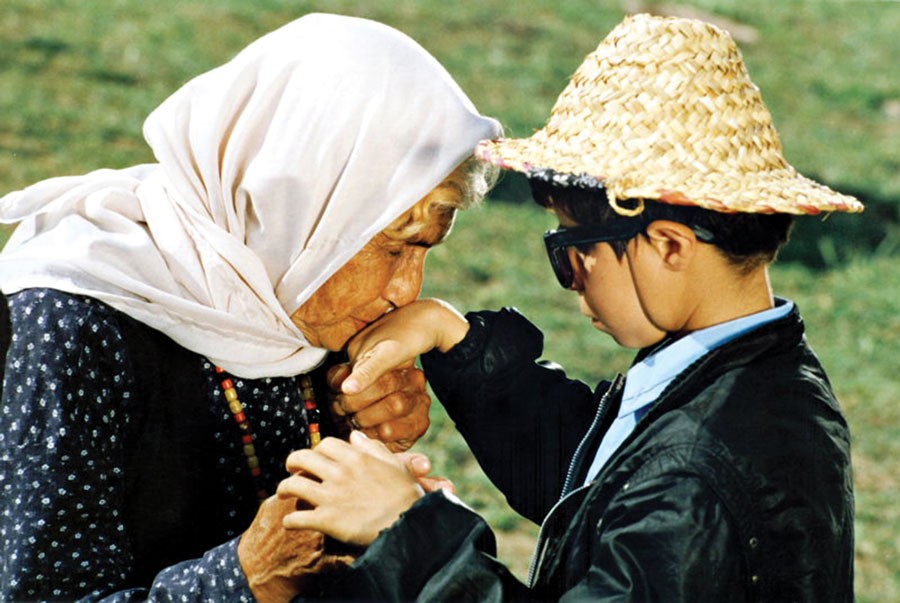

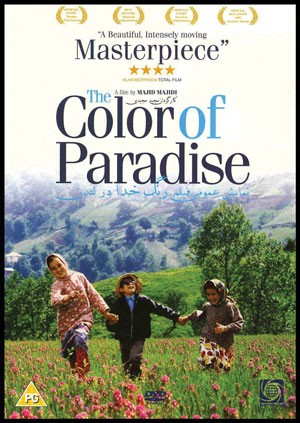
The Colour of Paradise (originally released as Rang-E Khoda, The Colour of God) is Majid Majidi’s fourth feature—here as director and screenwriter. It revolves around a blind boy’s return to his village for the summer recess, focusing on the widowed father-son relationship and the intense bond between the villagers and natural forces.
The film starts with a quasi-documentary look at the school for the blind in Tehran. The style alternates between long shots and close-ups, much like a blind person examining, then focusing on their surroundings. At the end of the school day, Muhammad waits for his father Hashem to pick him up, during which time he finds a fallen chick and returns it to its nest on a tree. Muhammad’s reactions to touch and sound are reflected in his actions (and the film’s editing) being broken into the smallest components. He gauges the distance between himself, the chick’s tweets, and the mother’s calls, then follows the bird’s tweets through the rustle of fallen leaves. Bird’s eye view shots suggest that nature is watching and calling for help. As for the soundtrack, sounds are highlighted in sonic close-ups as the boy hears them, while visual crossfades suggest that time and patience were required by the boy to complete his task. This scene exposes the audience to the boy’s capacities but more importantly, to Muhammad’s worldview.
 Things take a sad turn when the father arrives and asks the school principals to keep the boy for the summer. Eventually we learn that Hashem believes the blind boy to be a bad omen for his marriage plans—a case where tradition makes one blind. His request is declined and the boy is accompanied back to the village. There, he measures the changes that went on in his absence by touching faces or noticing the growth of vegetation. Hashem eventually takes Muhammad far away for an apprenticeship with a blind carpenter, but returns for him again after his grandmother dies and the marriage is called off. While crossing back through the ominous, overseeing forest, the father’s look shifts between humble and darker aspects. An accident on a bridge ensues and Muhammad and Hashem wake up to an almost mystical experience—as if washed on the shores of an afterlife where through synaesthetic skill (bringing together sight and sound) the boy sees the colour of God through his fingertips.
Jonathan Romney argues that the film relies too heavily on beautiful scenery to communicate to the viewer the outer beauty which a visually impaired person cannot see. It can also be argued that sound foregrounding techniques used in the film to depict hyper-sensitivity to sound and pantheistic forces, are nothing new to filmmaking. However, Rang-e Khoda’s strength relies on a narrative cycle in which contrasting intensities shift from a quasi-documentary style, to a scenic, intimate, and mystical feel. The film reflects on a person’s relationship between the outer and inner world. It highlights the capacities and limitations of sound and sight, which are often taken for granted and which have given us cinema itself.




Comments are closed for this article!