
TECH NEWS by Ryan Abela
In 1964 a very clever engineer, called Douglas Engelbart, invented a tiny device that changed the whole concept of how we interact with machines. By moving the device, a pointer on a screen moved, while tapping a button with your finger would cause an action. I’m talking about the mouse—a device now taken for granted—but back in its inception it had revolutionised the way we instructed machines. Instead of giving commands through a keyboard, the mouse made it possible to work in 2D.
The mouse kept evolving. So did the monitor, with new variations emerging. Nevertheless, despite all of these advancements we are still using the same concepts from the 60s. Our technology is still limited to 2D. We still construct 3D models on a 2D monitor, play 3D games on our flat screens, and input our instructions by moving a pointer in 2D space. Thankfully, science fiction has inspired new innovations. I remember the first time I saw Tom Cruise use a glove to control a futuristic UI (User Interface) in Minority Report by swiping his hands back and forth. It seemed like a hologram controlled by the movement of a finger. How cool would it be to have these types of devices? What if we could go beyond the screen and blend the digital and real world? Well, now we can.
Microsoft invests a lot of research in augmented reality and virtual space. In 2010, the Kinect was introduced, with cameras and an infrared sensor capable of capturing body and skeletal movements. Initially this let people play games through body motion, then others soon started using its APIs (Application Programme Interface) in creative ways like scrolling through the windows on the monitor, or to apply sound effects by combining different hand gestures. This new way to interact was strikingly similar to Minority Report.
The next leap forward was by Occulus VR™ that made virtual reality possible. Their device, called the Occulus Rift, consists of a head-mounted display that is sensitive to head movements. In a nutshell, what you see on the display is related to the way you move your head.
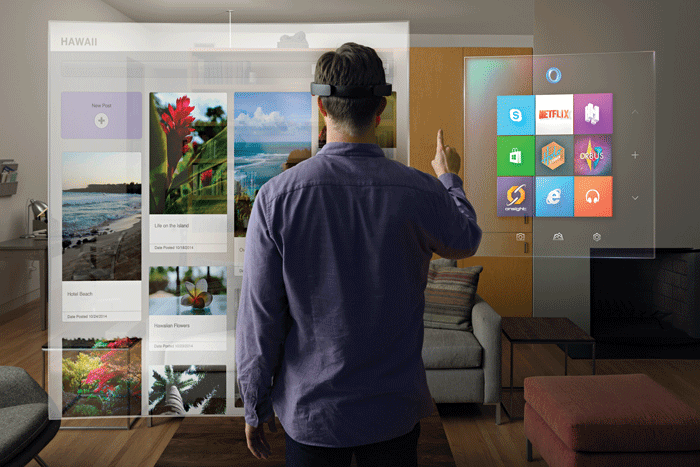
Microsoft retaliated. They pushed the boundaries by showing the world a demo of the real deal: HoloLens (available in January 2016 with Windows 10). The HoloLens is yet another head-mounted display—similar to Occulus Rift—that ‘inserts’ holograms or virtual objects in your display, while still showing the real surrounding environment. Imagine wearing a pair of clear glasses while looking at a table. Now imagine that you put a small sticker of a little teacup on your glasses. If you now position yourself in the right spot you will get the impression that the cup is sitting on the table. The HoloLens works in the same way.
So what’s the big deal about HoloLens? Their demo shows that for the first time we can work in a real 3D environment. Microsoft also combined hand-gesture technology with voice recognition technology into one device. Apart from easily visualising your work in 3D, the applications of this device are endless, with immersive games and intelligent systems entering your life.



Comments are closed for this article!