

Skip to content

Can We Become Zombies After Death?

Facebook
Twitter
LinkedIn

Alexanderhili

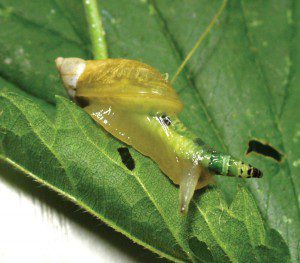
Leucochloridium paradoxum sp.

Yes, hypothetically we can be transformed into brain loving zombies. A scary answer to a scary question.However, before going out to buy a chainsaw to cut those zombies in half please be aware that a human zombie has never existed.
The rest of the animal kingdom isn’t so lucky. Different types of fungi, parasites, and pathogens have altered the life of other organisms and transformed them into zombies. One of the most graphic examples is Leucochloridium paradoxum, a tapeworm which has been observed to infect and take control of snails. After inserting itself into the snail’s body, the tapeworm slowly spreads and concentrates in its eye stalks making these look like tasty green caterpillars. In turn this makes the snail more eye-catching for hungry birds that are an intermediate host for this parasite. If that is not gory enough just wait for the zombie part.

The flatworm makes the snail do its bidding by exposing itself during daylight. By staying on the highest leaves pulsing the eye stalks making them look like tasty morsels ready for the picking by the hungry birds above.
This case is not unique. There are other species which are known to be zombified: ants, flies, crickets, and others. At the time of writing no fungus, parasite, bacteria, or virus has been found to infect and transform humans. Till then there is no need to get your zombie-proof chainsaw and sawn-off shotgun. •


Author

More to Explore

These Insoles Are Made for Monitoring: A Step Towards Preventive Healthcare 

What if healthcare could learn more about our health between appointments? Wearable technology is opening up new possibilities for continuous monitoring, and researchers at UM’s Centre for Biomedical Cybernetics and Department of Podiatry, in collaboration with Tarsos, are making significant contributions in this area. THINK went to learn more about a research project investigating how smart insoles could improve foot health monitoring for people with diabetes.

The Chosen One? Adoption Beyond the ‘Happy Ending’

You look at your reflection in the mirror. Your face tells a story of the generations that came before you. A familiar smile, or a shared eye colour, a resemblance that has probably been pointed out more than once. For most, such observations are brushed off with a smile and quickly forgotten. But what if your reflection raised more questions than answers?

Molecular Mail: Tiny Parcels for Tracking Tumours

Tumours are not discreet. As cancer cells grow and change, they release microscopic particles into their environment. Some of these particles enter the bloodstream. They are small, abundant, and, as researchers are beginning to realise, potentially informative. A Maltese research project is testing whether extracellular vesicles can provide a less invasive source of cancer information.

Comments are closed for this article!