
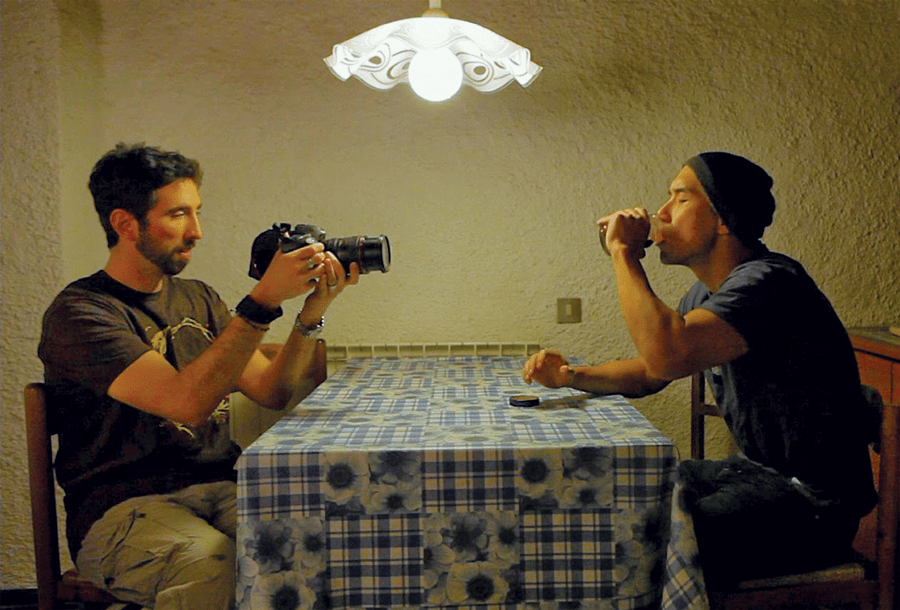

Noel: I was surprised to see that Afflicted was a vampire movie. From the trailer I gathered that it was going to be a contagion film. Vampires and pestilence share a common history but I was thinking 28 Days Later (2002) rather than The Addiction (1995). Unfortunately, despite finding it entertaining, it hardly broke any new ground in terms of vampire lore. Apart from its use of shaky-cam film-making, we’ve seen it all before.
Krista: Speaking of vampire lore—one highlight for me was the ill-fitting conversation referencing ‘traditional’ vampire lore (‘Well you should have the ability to turn into mist.’) which contrasted with that attempted ‘realist’ style. I’m actually impressed that they didn’t fall into the usual US stereotyping and made it happen in some ‘mysterious’ backwoods of ‘Old Europe’, but chose Paris as a hub of civilisation.
N: However the filmmakers still kept the vampire at arms’ length, making the monster foreign. As you pointed out, it’s not Transylvania or the Yorkshire moors; but it’s still an American who got infected by a European.
K: I also liked that despite their attempt to be innovative, they weren’t pretentious and even included traditional jump scares. I liked the first-person perspective (fpp) during the run—kind of game-like.
N: His heightened perception and supra-human powers reminded me of Chronicle (2012). It was fun but I wouldn’t want to watch it again.
K: The film spends a while setting up the friendship, so I’m not sure why it was ended early. It was a brave move and foregrounded isolation but the ending fell flat for me. I was disappointed with the half-hearted fight sequence and the cringe-worthy moralising and sentimentalising. That vigilantism could be an interesting parody and critique of institutionalised ‘justice’, seen in many ‘revenge films’. But here it just brought it back in line with conservative morality.
N: The moralising was a shaky-cam version of Louis in Interview with the Vampire (1995). Even if we had to isolate Derek’s crisis (the main character) and take it for what it was, it’s still not that interesting. It reminded me of a bad Pepsi Max advert, highlighting thrills and shallow been-there-done-that moments. On another note: what do you think about the found footage? Is it overstaying its welcome? I think so. I’m finding it tedious and boring for an entire feature-length film. Get a tripod!
K: I’m surprised that found footage has outlived its ‘novelty’ factor. I was kind of sceptical about that but several films, including V/H/S (2012), have convinced me there’s still life in it. I have three main reasons: (1) its DIY possibilities, which gives a new lease to indie directors without the backing of glossy production; (2) its proximity to some fpp video games—disorientation, chase; (3) it seems to be associated with the horror genre. Other genres borrow it as a device; horror embraces it. I’m not sure why exactly but ‘found text’ is found in horror literature, from Bram Stoker to Mark Z Danielewski, it’s an established device.
N: So, final verdict? I recommend Afflicted if you’re looking for an hour and a half of harmless entertainment. A camp-fire story for the tech-savvy generation.
K: Perhaps more of a ‘teen adult’ horror; it references a horror tradition, but doesn’t add much that’s new, perhaps more rewarding for less ‘seasoned’ horror fans.



Comments are closed for this article!