Skip to content

Humanised Fruit Flies

Facebook
Twitter
LinkedIn


Liliana Fleri Soler

Scientists consulted: Dr Edward Duca

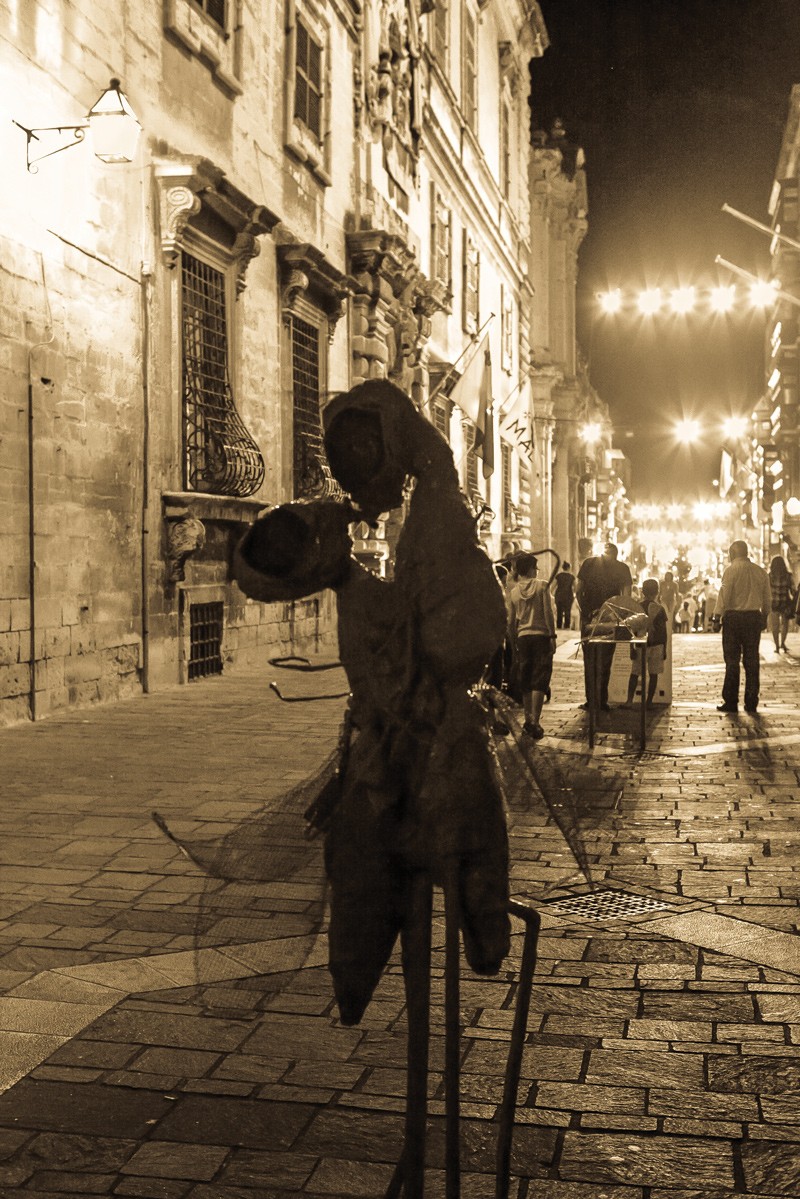
Location: Merchant Street,
St James Cavalier, now located in the Biology Department to be permanently exhibited in the new medical wing at the University of Malta

Fruit flies are red-eyed insects usually found circling bananas. They are 2mm pests that devastate and spoil millions worth of crops every year. Due to their similarity to humans, they are used as research subjects. Findings due to fruit flies have taught us humans a lot about ourselves.

Liliana Fleri Soler’s five-foot tall papier-mâché sculptures reflect this similarity in the fly’s complex courtship rituals, which go along these lines. The male sees an ‘attractive’ female and positions himself in front of her at an angle so that he appears bigger. Then, the male goes round and taps the female sending her many signals with his touch. He swivels back in front of her vibrating his wings to ‘sing’ and ‘soothe’ her. The female then allows him to explore her. At this point, he attempts to copulate with her. If she likes him, the two fruit flies mate. As you can see, this ritual is eerily similar to us humans. 


Part of Science in the City, Malta’s Science and Arts Festival

For more stories click here


Author

More to Explore

Squeezing Out Waste: Transforming Malta’s Olive Waste into Green Goods

While olive oil production generates vast amounts of nutrient-rich waste, approximately 98% of the antioxidant-rich phenolics in olives are lost during oil extraction. To combat rapid degradation, the OliveGREEN team is exploring a novel strategy using sulphur dioxide and enzymes to stabilise olive pomace. THINK speaks with Dr Frederick Lia to learn why saving this discarded byproduct makes a difference.

More Than Four Walls: The Influence of the Library Space on Student Wellbeing

Academic libraries are often framed as quiet repositories of knowledge, but their influence runs deeper. As student mental health concerns intensify, these spaces are emerging as critical environments for connection, comfort, and care. Beyond books and databases, the design, atmosphere, and activities of a library can shape how students feel, cope, and belong within the wider university experience.

The Limb That Learns

A prosthetic limb is always a work in progress. Even after fitting and adjustments, the body keeps changing. Weight shifts. New pressure points show up. A socket that feels fine one month might cause irritation the next. For many people, comfort relies on a device that cannot sense what is happening.

Comments are closed for this article!