

Freeviewpoint television (FTV) is expected to become the ultimate 3D TV experience. With FTV, the viewer can choose from which angle and position to view a scene. Want to watch football from above, the East Wing, or with your fellow fans? At the press of a button, with FTV you can. For FTV to work, the same scene needs to be captured from a number of different viewpoints and the virtual scenes in between generated. To broadcast the service requires a huge bandwidth, which on your mobile would quickly soak up all your data. Current mobile FTV frameworks cannot handle the broadcast capacity required and FTV has never been deployed over a specific cellular technology.
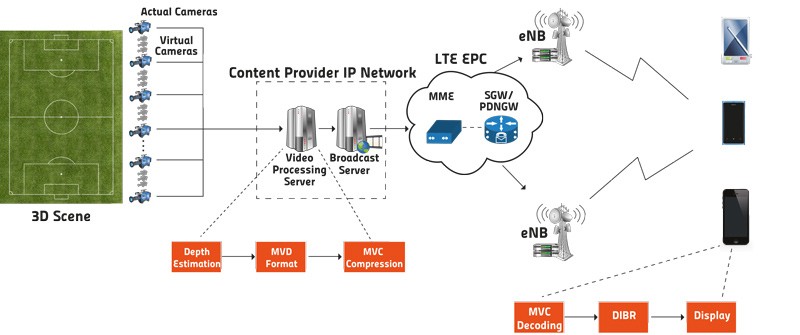
Terence Zarb (supervised by Dr Ing. Carl James Debono) proposed a framework to compress and transmit FTV to mobile devices. The system was adapted for the next generation long-term evolution (LTE) networks, currently available on high-end smartphones. To reduce bandwidth and reduce mobile phone workload, the FTV broadcast data is processed at the transmitting end, before it is sent over the mobile network. The physically captured views are transmitted. Depending on the user’s choice, the mobile phone either presents one of these views or generates an arbitrary viewpoint. By using the novel proposed framework, the bandwidth required was reduced by over 70% compared to current methods. It also provided a better viewing experience.
Taken together, the proposed framework can realistically be deployed on LTE networks, which means we might be seeing an incredibly innovative way of viewing sport, documentaries and maybe even films on our 3D TVs — is that enough to make you buy one?
This research was performed as part of a Masters of Science in Information and Communication Technology at the Faculty of Information and Communication Technology. The research is partially funded by the Strategic Educational Pathways Scholarship Scheme (Malta). The scholarship is part-financed by the European Union – European Social Fund, under Operational Programme II – Cohesion Policy 2007-2013, “Empowering People for More Jobs and a Better Quality of Life”.




Comments are closed for this article!