
I first heard about COST (European Cooperation in Science and Technology, a networking platform for scientists www.cost.eu) way back in 1996 during a pharmacokinetics meeting in Athens. Some participants mentioned that their attendance had been funded by COST. So on my return I contacted the Malta Council of Science and Technology to try and obtain more information. When I learnt that COST funds EU networking I quickly applied to become a member of a COST action (this is what COST calls a network). After bureaucratic leaps and bounds I become Malta’s representative on a COST action. It certainly opened new horizons to me and the networks I formed with top researchers in Europe were unique.
By 2010 my enthusiasm resulted in MCST nominating me as Malta national contact point for COST. It has been of huge satisfaction that in these three brief years Malta’s participation has risen from 6 actions to over 100. Over 150 Maltese researchers take part in COST.
Why is COST so important for Malta?
The complaint I hear most often in Malta, not only in academic circles but also among SMEs (small to medium enterprises), is that research in science is only for the elite, that it is too high brow and that it is not relevant to Malta. COST proves otherwise. What else could link disaster bioethics, to colour and space in cultural heritage to the comparison of European prostitution policies, with submerged prehistoric archaeology? Other links include the quality of suburban building stocks, integrated fire engineering and response, and language impairment in a multilingual society. COST also funds networks across a whole spectrum of research from the humanities to the fundamental sciences including string theory to childbirth in various cultures.
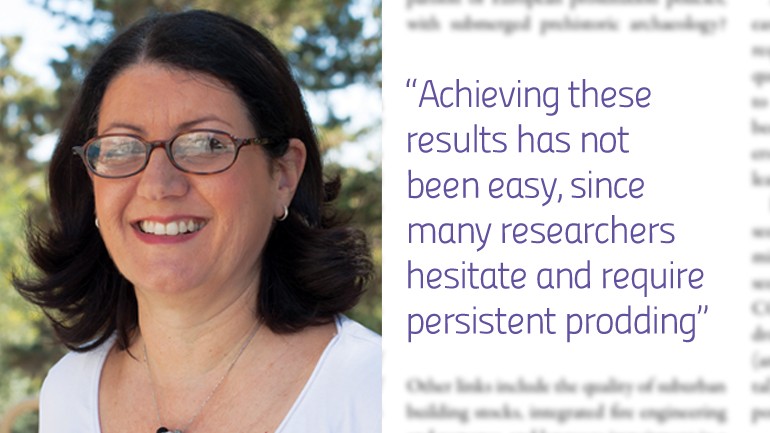
Participating in a COST action involves very simple administrative and funding procedures. For once, our small size is an added advantage since every COST country is allowed to nominate two members to participate in each action, putting Malta COST researchers at par with researchers from much larger countries. Achieving these results has not been easy, since many researchers hesitate and require persistent prodding. There are frequent reminders and one to one meetings to persuade them to participate. It has been a real eye-opener meeting researchers in Malta from different disciplines and learning about their research.
Deciding to participate in COST may seem a small step to some, an added administrative burden to others, while some see it as another travel commitment. COST offers the response to the conundrum of how to overcome our physical (and perhaps in some instances also mental) insularity. You should not let this opportunity pass…
COST in Malta is managed by the Malta Council for Science and Technology. For more information see www.mcst.gov.mt/networking/cost or contact Dr Janet Mifsud, COST CNC, (+356 23402582/2845, janet.mifsud@um.edu.mt) or cost.mcst@gov.mt




Comments are closed for this article!