
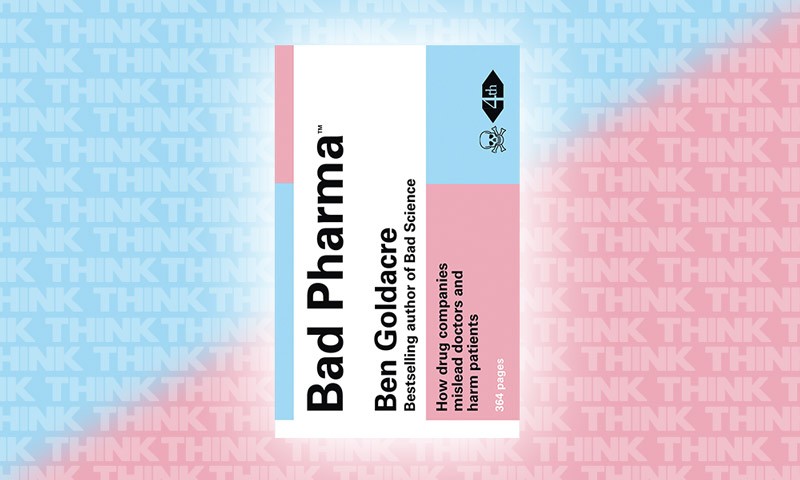

The author Dr Ben Goldacre is on a mission. The $600 billion pharmaceutical industry, some doctors, regulators, medical journals, and whole governments should be trembling. Goldacre wants to show the truth behind how our medicines are made. He wants transparent companies, properly informed patients, solid research, and cheap, effective drugs, preferably for all.
In typical Goldacre style, he rants. Ignore the apparent chip on his shoulder. His statements are thoroughly based on facts. The facts are shockingly scary.
Take the drug Tamiflu, the supposed miracle cure for flu. The pharmaceutical company Roche made over €500 million in 2009 on the back of the swine flu scare. The drug is known to reduce flu symptoms by a few hours, a hefty price tag for a spot of relief. Initially, Roche said that it reduces complications by 68%, amazing! Though when the gold standard reviewer Cochrane started scratching the surface they hit a brick wall. Roche refuses to publish data requested years ago and we still do not know how effective it is.
Even regulators get it wrong by being too business friendly or opaque. Diabetes drug Rosiglitazone was recently taken off the market after over 10 years of intimidating researchers who published data against the drug in 1999. Rosiglitazone increases heart problems by 43%. Regulators failed to share data transparently, which slowed action, an endemic problem.
Pharma has even failed cancer patients by stopping trials early to make drugs look better. Trials can also be run longer than needed to fuzz data. Goldacre lists endless examples to buttress his arguments.
Companies spend double on marketing drugs compared to research. In the US they can reach and influence consumers directly irrespective of efficacy, price, or need. Where direct marketing is banned, companies shift budgets and reach doctors through drug reps, people whose job it is to convince medics that their company’s drug is the best. Pharma even disguises marketing as research fooling doctors and wasting their time. Well-respected doctors are also paid handsomely to talk about products.
Apart from scandalous facts, Goldacre is a master of explaining science simply and clearly. Chapter 2 has a great introduction on how drugs are made. He clearly explains the difference between relative risk or absolute risk, or how bias and probability are manipulated by pharmaceuticals. His lucid style makes this book a great read and well recommended for anyone wanting to know the dirty secrets behind pill manufacturing.
Thankfully, Goldacre also suggests how it could be solved. My only advice is not to debunk the whole system when reading this book, remember the good stuff: life-saving antibiotics, disease eradicating vaccines and much more. The current system just needs some serious tweaking to remove the bad loop holes Big Pharma exploit to meet profit margins. But drug research has to go on.




Comments are closed for this article!