

Do you ever recall those moments in nature, where tiny insects seem to mistake you for a tree? Not only do they walk vertically upwards with incredible grip, but as they are brushed off and fall to the ground, they just nonchalantly walk away. No big deal. Except, when put into perspective, an ant falling from your arm is as though a person fell off a rooftop and walked away untouched. Why do small insects, and ants specifically, never seem to take any fall damage?
After some research, it turns out to be a curious physics problem. Don’t let the word ‘physics’ throw you off though, as everything around us (well, almost everything) can be explained by some law of physics or another.
Let’s Nerd Out for a Quick Minute
The concept that most accurately explains the surprising durability of ants is the effect of mechanics and forces during free fall in a fluid* [x]. This is quite a complex area of physics as there are many factors and little things influencing each other.
An ant in free fall reaches what is called terminal velocity. Terminal velocity is defined as the constant speed reached by an object in free fall in a fluid due to resistance from the fluid itself. In other words, as an ant falls from your shoulder, the downward force on it (gravitational force and, therefore, the ant’s weight – which is almost negligible) are opposed by air resistance. The ant’s weight is a function of gravity acting on the ant’s mass, giving us the formula Weight = Mass x Gravity.
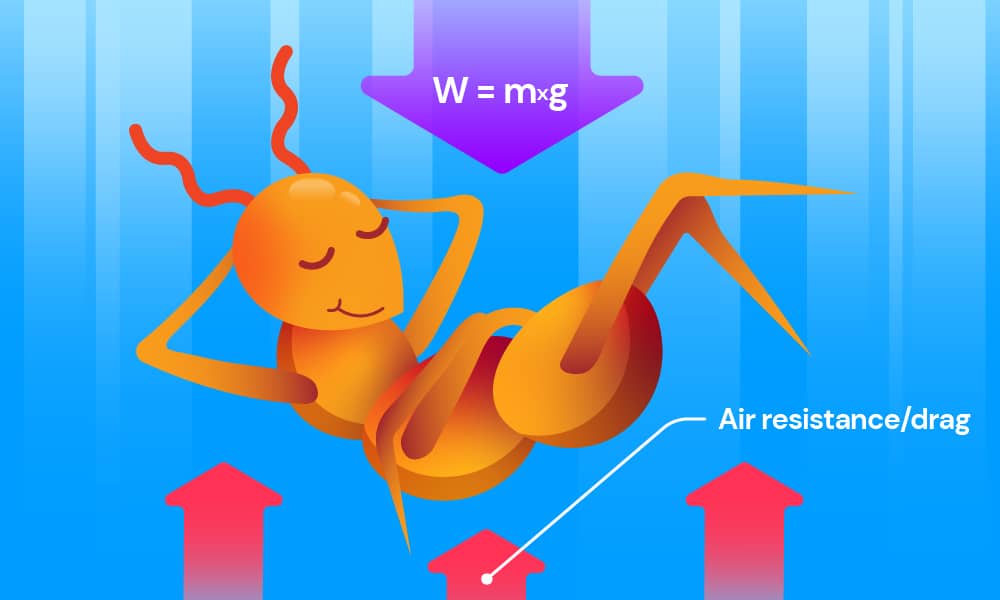
To conceptualise this better, imagine a skydiver. As the skydiver is much heavier by ratio in comparison to an ant, the skydiver accelerates at a faster rate. So they require a ‘mechanical aid’ in the form of a parachute in order to avoid becoming a human-shaped pancake upon reaching the ground. The parachute is there to increase the surface area of the skydiver, maximising the upward force to balance out the downward force on the skydiver in order to lower their terminal velocity and make a safe landing.
Since ants are very tiny, terminal velocity is reached quite quickly, minimising the force of impact when the ant hits the ground, picnic table top, or other solid surface. And though there is not a lot of air resistance acting on a falling ant, there is also no desperate need for a large upward force. This is because the downward forces are quite small, as you can assume, since the mass of an ant is so small and could even be rounded down to zero. This is what protects them in their fall.
So, do ants really have superpowers? Realistically, no. However, they can help us realise how the laws of physics may look different depending on the size of their subject.
*Although you might associate the word ‘fluid’ with water, it in fact refers to any liquid or gas with similar properties. Objects experience the same forces while falling through air, which becomes the ‘fluid’ in this example.



Comments are closed for this article!