
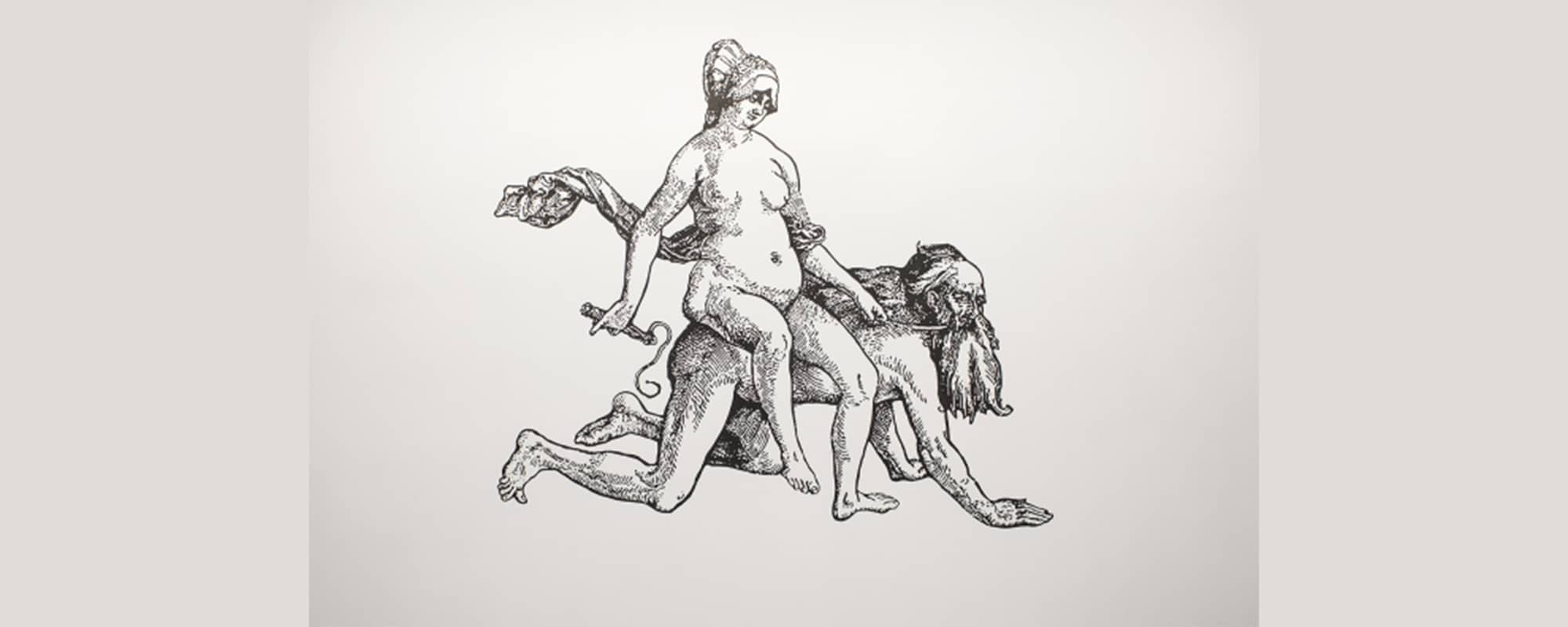
The first in our new THINK Oddities series, where we take a look at the many odd things that dot history! And what better way to start than with the story of Aristotle playing sub?
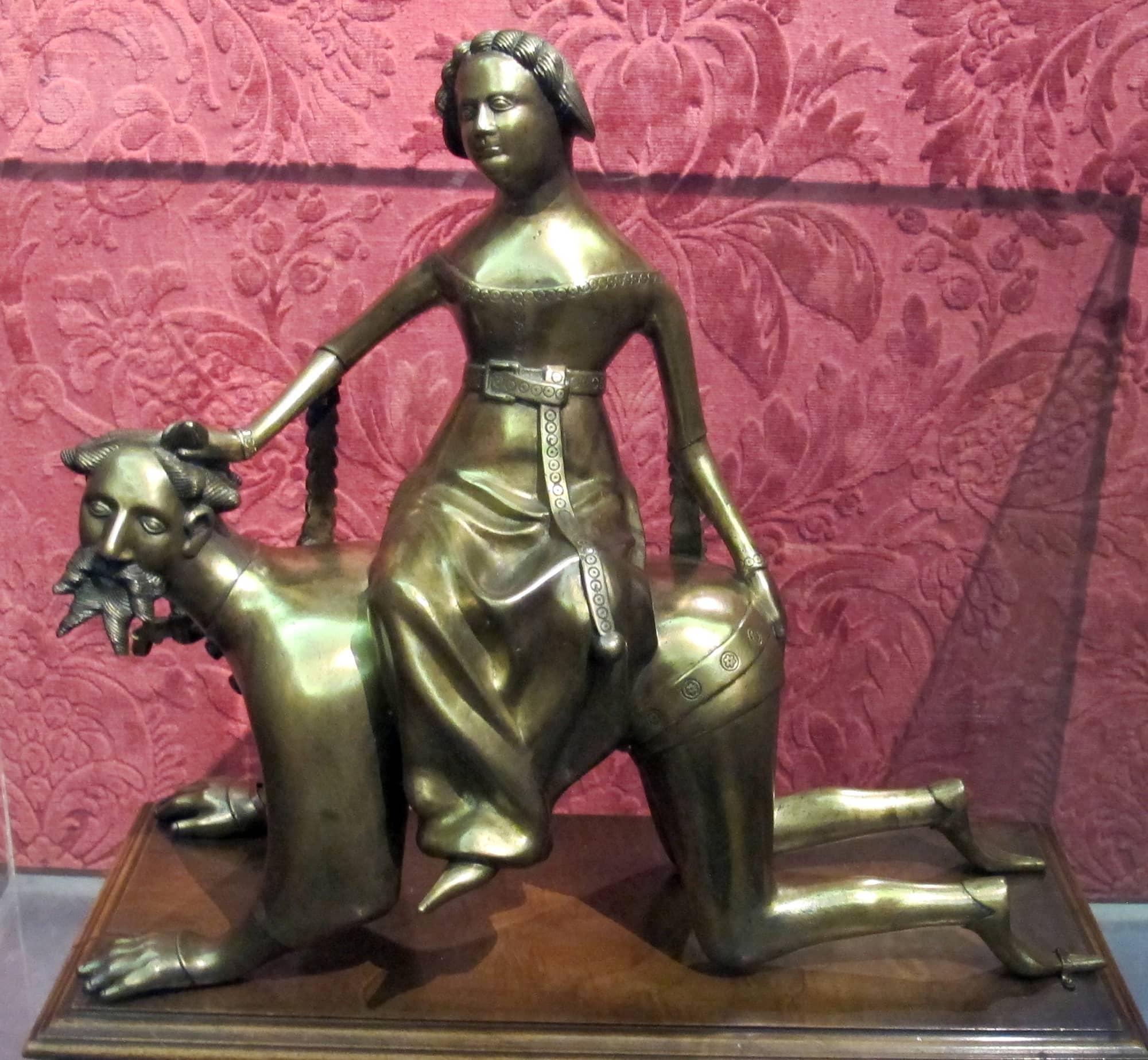
Aristotle, viewed by many as one of the founders of Western philosophy, was also quite the kink according to medieval legend. The tale of Phyllis and Aristotle has inspired engravings, oil paintings, stained glass, and all manners of art. But how did Aristotle the deviant end up dominated and ridden like a horse (complete with saddle, bit, and whip)?
Aristotle was teaching his pupil, Alexander the Great, and advised him to avoid the voluptuous Phyllis, as she was distracting him from his kingly duties. In some versions of the story, Phyllis is the mistress of Alexander’s father, while in others she is simply Alexander’s lover.
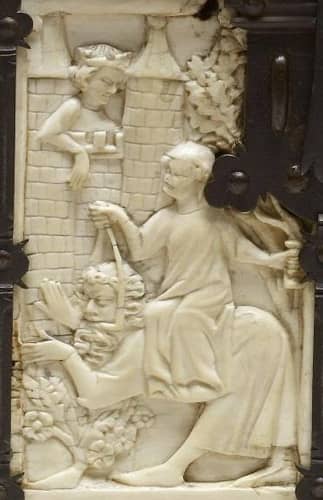
Phyllis, upon hearing this, was understandably hurt and vowed to avenge herself on the philosopher. She told Alexander to watch the castle gardens from the roof of the bastion as she sauntered over to Aristotle’s study. Aristotle, upon seeing Phyllis, was overcome by desire and begged her to be his (even great philosophers are no stranger to hypocrisy).
Phyllis obliged the philosopher on the condition that Aristotle got down on all fours, donned a saddle and bridle, and let her ride him across the palace grounds, cracking her whip. Aristotle, being the simp that he was, accepted, humiliating himself not only in front of his student but the entire castle.
The story of Phyllis and Aristotle was immensely popular in the middle ages. Artists chiselled, engraved, and painted scenes from the story on all manner of objects, from marble columns to ivory jewel boxes. The tale, alongside the story of ‘Virgil in the Basket,’ is often considered an example of the ‘Power of Women’ genre which was popular at the time. They are seen as cautionary tales about the triumph of a seductive woman over male intellect. While the story has since dwindled in popularity, one thing is certain: even philosophers need to get their freak on!
Further Reading
Soth, A. (2018). That Time a Woman Rode Aristotle Around Like a Horse – JSTOR Daily. Retrieved 27 June 2022, from https://daily.jstor.org/that-time-a-woman-rode-aristotle-around-like-a-horse/
The British Museum. (2022). That time Aristotle was ridden like a horse, and other Gothic Ivory tales | Curator’s Corner S7 Ep4 [Video]. Retrieved from https://www.youtube.com/watch?v=IA0sWopdLxs
Note: Banner image is from Irene Solà. Mural, black ink on wall. The image itself can be found here.




Comments are closed for this article!